
The Pwani Space University is a project within the Education and Skills theme. It is a proposal from the Pwani 2050 plan for a new university on the north coast, built around the proposed Lamu Spaceport, that would teach astronomy, physics and engineering and host incubation space for space start-ups, on the model of Singapore’s Biopolis research hub. The plan suggests partnering with the International Space University, whose French campus closed in July 2026, and with Arizona State University’s School of Earth and Space Exploration. It is a concept only: no site, budget, sponsor or partner agreement exists, and the spaceport it would serve is itself at the feasibility stage.
What it is
The Pwani 2050 plan places the university at the northern end of its coastal development corridor, alongside the spaceport, public viewing galleries, hotels for visiting staff and the public, and “space startups incubation facilities” which it compares to Singapore’s Biopolis. The university’s proposed subjects are astronomy, physics and engineering. This page treats the incubator as part of the same project.
The plan describes the spaceport as being in Manda Bay, Lamu. The Kenya Space Agency’s own Terms of Reference for the spaceport place it instead “in the general area of Kipini, between Malindi and Lamu”, to be developed as a public private partnership under the PPP Act, 2021.1 Kipini lies at the mouth of the Tana River,2 which is why this page lists Tana River County alongside Lamu and Kilifi. Where the university would go therefore depends on where the spaceport is finally sited.
The proposed partners
The International Space University (ISU) was founded in 1987 and ran its central campus at Illkirch-Graffenstaden, near Strasbourg, where it taught a Master of Space Studies, while its summer Space Studies Program moves to a different host city each year.3 On 7 July 2026 the Strasbourg court ordered the judicial liquidation of ISU France, the association that ran the campus, after rejecting a proposal from staff to keep it going.4 Its management announced that it ceased all activity on 17 July 2026.5 Accounts attribute the collapse to cuts in support from the French space agency CNES, the European Space Agency and local government; about 20 staff lost their jobs.6
The wider ISU continues through its Massachusetts parent. Co-founder Bob Richards describes it as “the mothership”, and an “ISU Global” initiative launched shortly before the liquidation aims to build a network of affiliate campuses and partners.7 ISU Global’s website states that its campus initiative is “open to academic institutions, accredited universities, national space agencies and local governments to establish ISU regional hubs and affiliate campuses”.8 That invitation is the clearest opening for a Kenyan proposal. It comes with a caution: a separate group of former faculty is trying to rebuild ISU in Strasbourg as a cooperative, and commentators have flagged a possible dispute over who holds the ISU name.9 No African partner or new campus has been announced under ISU Global.
Arizona State University’s School of Earth and Space Exploration (SESE) was founded in 2006, is directed by the geologist Ramón Arrowsmith, and led NASA’s Psyche asteroid mission; in 2022 the US Space Force made ASU a member of its University Partnership Program.10 ASU’s documented ties with Kenya are real but sit outside space science. In 2018 ASU signed a collaboration agreement with Kenyatta University covering exchanges and research,11 and in December 2022 ASU’s Thunderbird School of Global Management and the Konza Technopolis Development Authority announced a partnership, in the presence of President William Ruto, whose listed areas include “space leadership”.12 ASU also hosts Mastercard Foundation Scholars, including Kenyans.13 No link between SESE itself and a Kenyan institution has been found.
The model
Biopolis opened at Singapore’s one-north district in 2003 and co-locates the public research institutes of A*STAR with corporate laboratories; it grew to 13 buildings housing more than 2,500 scientists, and A*STAR credits its success to co-location and public private partnership.14 Biopolis sits beside an established research university and hospital system. A site near Kipini or Lamu would have neither, which is the main difference between the model and the proposal.
Rationale
The case rests on the spaceport. The Kenya Space Agency’s strategic plan for 2023 to 2027 lists among the agency’s functions capacity building in space science and engineering, support for “incubation and nurturing of start-ups”, promotion of space education, and the commercialisation of infrastructure “such as spaceport”.15 The draft Kenya Space Bill, 2024 would let the agency “establish space research and training centres” and direct it to “promote space science and technology education programs in institutions of higher learning”.16 The spaceport’s own Terms of Reference, by contrast, provide training only for “at least fifteen (15) Public officials” on the project team. A university and incubator would fill a gap that the official documents name but do not fund.
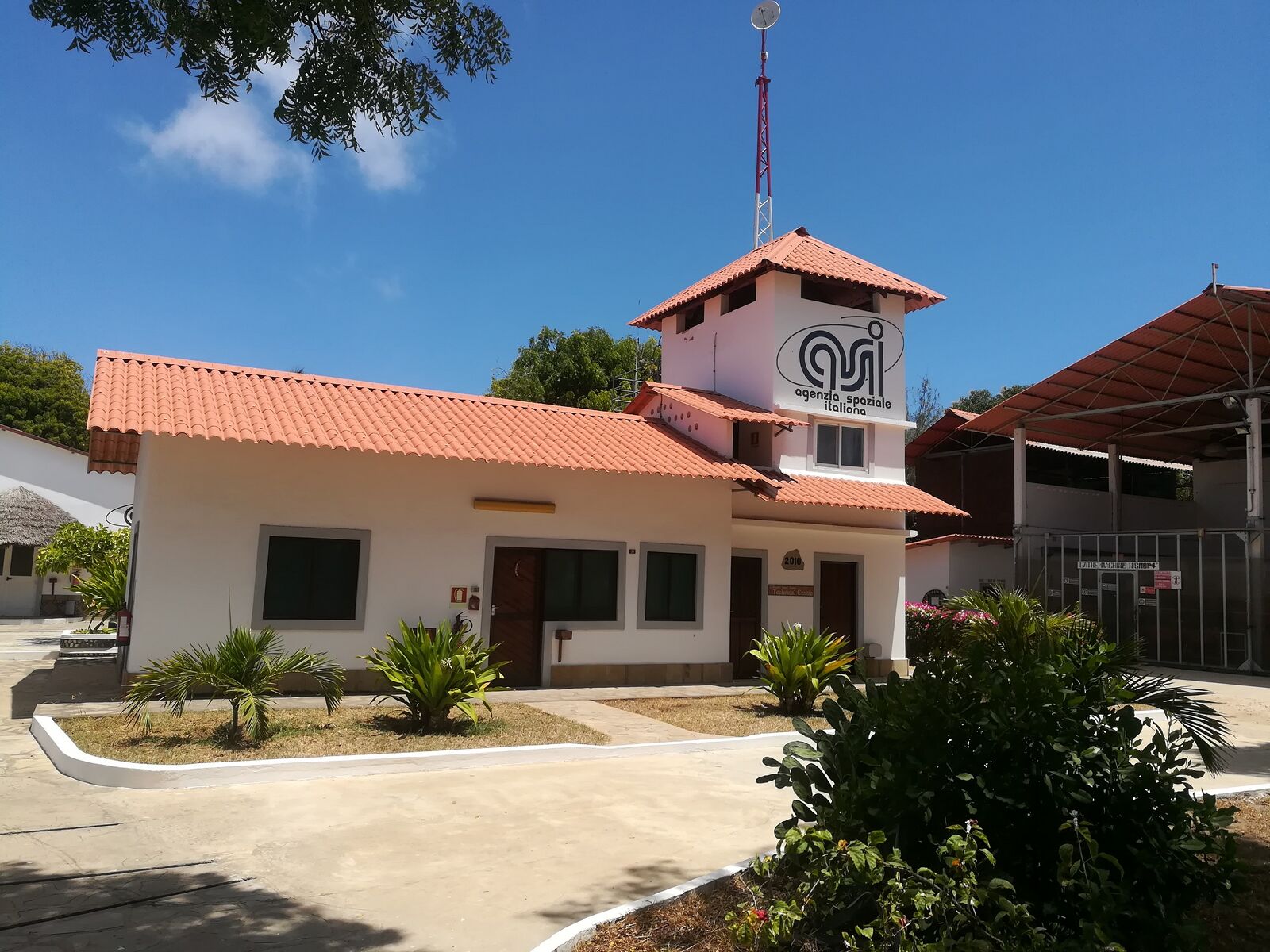
The coast already has a foundation to build on. The Luigi Broglio Space Centre at Malindi is the Italian Space Agency’s base outside Italy, where the San Marco platforms launched satellites between 1967 and 1988 and which now receives satellite data and tracks launches; the Italian Space Agency describes plans for an International Center for Space Education in Africa there.17 At a joint steering committee in Rome in April 2026, Kenya’s Ministry of Defence reported that 13 Kenyans were pursuing doctorates in Earth observation under the Italy and Kenya agreement, that 15 Kenyans a year would be sponsored for postgraduate study in Italy, and that the agreement runs to 2035.18 Kenyan university teams built the country’s first nanosatellite, 1KUNS-PF, deployed from the International Space Station in May 2018, and Kenyan engineers built Taifa-1, launched in April 2023.
Status and timeline
The university exists only as a proposal in the Pwani 2050 plan. The Kenya Space Agency was established by the Kenya Space Agency Order, 2017,19 and issued its Terms of Reference for a transaction adviser on the spaceport in December 2025. In October 2026 Space in Africa reported that the PPP Directorate and the agency had signed a funding agreement marking the formal onboarding of a transaction adviser, who was not named.20 The space bill that would give the agency its training role has not been found among enacted laws. No approach to ISU Global, ASU or any Kenyan university about this proposal has been made public.
How the project would be procured
There is no Terms of Reference, feasibility study or budget for a space university. The proposal could take the form of a programme or campus within an existing chartered university, an ISU affiliate hub under the ISU Global invitation, or a training centre established by the Kenya Space Agency if the space bill passes.
Who is involved
The proposal comes from the Pwani 2050 plan. The Kenya Space Agency, a state corporation under the Ministry of Defence, leads the spaceport and has the mandate to promote space education. The International Space University and Arizona State University’s School of Earth and Space Exploration are named in the proposal as possible partners; neither has been approached publicly. The Italian Space Agency’s Malindi centre and the University of Nairobi’s space science work are the nearest existing institutions.
- Kenya Space Agency
- International Space University (ISU Global)
- ASU School of Earth and Space Exploration
Concerns and counterpoints
No one has yet commented in public on this proposal. The points below are the main critiques of space spending in developing countries, of new universities in Kenya and of the north coast as a site, and are given as general context.
Public money and priorities
Critics of African space programmes have long asked whether governments should spend on space while most citizens are poor; a 2016 Daily Mail report by Ian Birrell, republished by IOL, quoted the British TaxPayers’ Alliance objecting to aid for countries that run space programmes.21 Kenya’s own space budget is tight: in February 2025 the Principal Secretary for Defence asked Parliament for adequate funding to build “a state-of-the-art space Centre”.22 Supporters reply that space capacity serves Earth observation, agriculture and disaster response, which is the emphasis of the Kenya Space Agency’s own plan.
The state of Kenya’s universities
Ishmael Munene wrote in 2016 that about 70 per cent of Kenya’s 33 public universities had been created in 2012 and 2013, many as “cheap, low-quality satellite campuses”, and that the regulator lacked the capacity to enforce standards.23 In July 2025 Treasury Cabinet Secretary John Mbadi said the government could no longer fund universities at current levels and proposed staff cuts and the sale of satellite campuses.24 A new standalone university would compete for the same shrinking public money, which argues for building on an existing institution or an ISU hub rather than chartering a new one.
Partners and site
ISU’s own collapse shows the risk of depending on agency subsidies, and its future direction is contested. The north coast has a difficult security record. Al-Shabaab attacked the Manda Bay airfield and Camp Simba in January 2020,25 and the Auditor-General found in 2025 that the LAPSSET highway from Lamu towards Garissa and Isiolo was either unfinished or not yet started, with militant attacks on road crews disrupting work.26 Both bear on recruiting international staff and students. The spaceport itself has no named launch customer, so a university planned around it would be ahead of the demand it is meant to serve.
Sources
- Kenya Space Bill, 2024 (reviewed second draft), Kenya Space Agency, February 2024.
- Terms of Reference for the commercial spaceport, Kenya Space Agency, December 2025.
- Kenya Space Agency Strategic Plan 2023-2027 (popular version), Kenya Space Agency (34 MB, linked rather than uploaded).
- ISU Global Partnership Registry, International Space University.
- Luigi Broglio Space Center, Italian Space Agency.
- Biopolis: Ten years on, A*STAR.
Footnotes
-
Terms of Reference: Transaction Advisory Services for Development of a Commercial Spaceport, Kenya Space Agency, December 2025, page 3. ↩
-
Kipini, Wikipedia, read 15 October 2026. ↩
-
International Space University, Wikipedia, read 15 October 2026. ↩
-
ISU Central Campus Liquidated, Replaced by ISU Global, Douglas Messier, 8 July 2026. ↩
-
ISU France Ceases Operations, Douglas Messier, 18 July 2026 (reproducing the management’s open letter of 17 July 2026). ↩
-
L’International Space University liquidée, l’Eurométropole de Strasbourg cherche un repreneur pour le site, Le Journal des Entreprises, 16 July 2026. ↩
-
ISU Founder Shares a Vision Beyond Liquidation, Douglas Gorman, Payload, July 2026. ↩
-
ISU Global Partnership Registry, International Space University, read 15 October 2026. ↩
-
Strasbourg Group Plans Revival of ISU France, Douglas Messier, 12 July 2026. ↩
-
School of Earth and Space Exploration, Wikipedia, read 15 October 2026. ↩
-
Collaborative symposium welcomes ASU partnership with Kenyatta University, Kimberly Koerth, ASU News, 13 May 2019. ↩
-
ASU Thunderbird celebrates new partnership with Kenya to accelerate 100 Million Learners Global Initiative, Dasi Styles, ASU News, 15 December 2022. ↩
-
ASU supports Mastercard Foundation Scholars across Africa, ASU News, 18 September 2025. ↩
-
Biopolis: Ten years on, A*STAR Research, 19 November 2013. ↩
-
Strategic Plan 2023-2027 (popular version), Kenya Space Agency, 2023. ↩
-
Kenya Space Bill, 2024 (reviewed second draft), Kenya Space Agency, February 2024, PDF page 15, section 26. ↩
-
Luigi Broglio Space Center, Italian Space Agency, read 15 October 2026. ↩
-
PS Defence Leads Kenyan Delegation in Rome, Italy, Ministry of Defence, 3 April 2026. ↩
-
Our Mandate, Kenya Space Agency, read 15 October 2026. ↩
-
Kenya Advances Its Commercial Spaceport Plans With New Funding Agreement, Rihab Ben Moussa, Space in Africa, 2 October 2026. ↩
-
Africa’s mad dash to space, Ian Birrell, IOL (from the Daily Mail), April 2016. ↩
-
Defence PS asks Parliament for adequate funding to enhance Kenya’s space capabilities, Ministry of Defence, 21 February 2025. ↩
-
Kenya’s universities are in the grip of a quality crisis, Ishmael Munene, The Conversation, 16 February 2016. ↩
-
Universities facing cash crisis as mass layoffs, closure of satellite campuses loom, Mary Muoki, Citizen Digital, 24 July 2025. ↩
-
Camp Simba attack, Wikipedia, read 15 October 2026. ↩
-
LAPSSET gamechanger project a pipedream as key projects stall, Eliud Kibii, The Star, 27 July 2025. ↩
Related pages
Holding
Broglio Space Centre Malindi
The Italian Space Agency (ASI) building at the Luigi Broglio Space Centre, Malindi, Kenya, photographed on 14 February 2018 by Juan Kulichevsky and published on Flickr (https://www.flickr.com/photos/10644906@N04/40407193701/), via Wikimedia Commons (https://commons.wikimedia.org/
Holding
Kenya Space Bill 2024 second draft
The Kenya Space Bill, 2024, reviewed second draft, published by the Kenya Space Agency (PDF created 5 February 2024).
Holding
TERMS OF REFERENCE TRANSACTION ADVISORY SERVICES FOR DEVELOPMENT OF A COMMERCIAL SPACEPORT DECEMBER 20
he Government of Kenya's Terms of Reference for the PPP tender for the Lamu Space Port.
Reference
International Space University, Wikipedia, read 15 October 2026.
International Space University, Wikipedia, read 15 October 2026.
Reference
ISU Global Partnership Registry, International Space University, read 15 October 2026.
ISU Global Partnership Registry, International Space University, read 15 October 2026.
Reference
Defence PS asks Parliament for adequate funding to enhance Kenya's space capabilities, Ministry of Defence, 21 February
Defence PS asks Parliament for adequate funding to enhance Kenya's space capabilities, Ministry of Defence, 21 February 2025.
Reference
Universities facing cash crisis as mass layoffs, closure of satellite campuses loom, Mary Muoki, Citizen Digital, 24 Jul
Universities facing cash crisis as mass layoffs, closure of satellite campuses loom, Mary Muoki, Citizen Digital, 24 July 2025.
Reference
Kenya's universities are in the grip of a quality crisis, Ishmael Munene, The Conversation, 16 February 2016.
Kenya's universities are in the grip of a quality crisis, Ishmael Munene, The Conversation, 16 February 2016.
Reference
School of Earth and Space Exploration, Wikipedia, read 15 October 2026.
School of Earth and Space Exploration, Wikipedia, read 15 October 2026.
Reference
Strategic Plan 2023-2027 (popular version), Kenya Space Agency, 2023.
Strategic Plan 2023-2027 (popular version), Kenya Space Agency, 2023.
Reference
ASU Thunderbird celebrates new partnership with Kenya to accelerate 100 Million Learners Global Initiative, Dasi Styles,
ASU Thunderbird celebrates new partnership with Kenya to accelerate 100 Million Learners Global Initiative, Dasi Styles, ASU News, 15 December 2022.
Reference
Collaborative symposium welcomes ASU partnership with Kenyatta University, Kimberly Koerth, ASU News, 13 May 2019.
Collaborative symposium welcomes ASU partnership with Kenyatta University, Kimberly Koerth, ASU News, 13 May 2019.
Reference
ISU France Ceases Operations, Douglas Messier, 18 July 2026 (reproducing the management's open letter of 17 July 2026).
ISU France Ceases Operations, Douglas Messier, 18 July 2026 (reproducing the management's open letter of 17 July 2026).
Reference
Terms of Reference: Transaction Advisory Services for Development of a Commercial Spaceport, Kenya Space Agency, Decembe
Terms of Reference: Transaction Advisory Services for Development of a Commercial Spaceport, Kenya Space Agency, December 2025, page 3.
Reference
L'International Space University liquidée, l'Eurométropole de Strasbourg cherche un repreneur pour le site, Le Journal d
L'International Space University liquidée, l'Eurométropole de Strasbourg cherche un repreneur pour le site, Le Journal des Entreprises, 16 July 2026.
Reference
Our Mandate, Kenya Space Agency, read 15 October 2026.
Our Mandate, Kenya Space Agency, read 15 October 2026.
Reference
ISU Founder Shares a Vision Beyond Liquidation, Douglas Gorman, Payload, July 2026.
ISU Founder Shares a Vision Beyond Liquidation, Douglas Gorman, Payload, July 2026.
Reference
Kenya Space Bill, 2024 (reviewed second draft), Kenya Space Agency, February 2024, PDF page 15, section 26.
Kenya Space Bill, 2024 (reviewed second draft), Kenya Space Agency, February 2024, PDF page 15, section 26.
Reference
Luigi Broglio Space Center, Italian Space Agency, read 15 October 2026.
Luigi Broglio Space Center, Italian Space Agency, read 15 October 2026.
Reference
ASU supports Mastercard Foundation Scholars across Africa, ASU News, 18 September 2025.
ASU supports Mastercard Foundation Scholars across Africa, ASU News, 18 September 2025.
Reference
Kipini, Wikipedia, read 15 October 2026.
Kipini, Wikipedia, read 15 October 2026.
Reference
Strasbourg Group Plans Revival of ISU France, Douglas Messier, 12 July 2026.
Strasbourg Group Plans Revival of ISU France, Douglas Messier, 12 July 2026.
Reference
PS Defence Leads Kenyan Delegation in Rome, Italy, Ministry of Defence, 3 April 2026.
PS Defence Leads Kenyan Delegation in Rome, Italy, Ministry of Defence, 3 April 2026.
Reference
Africa's mad dash to space, Ian Birrell, IOL (from the Daily Mail), April 2016.
Africa's mad dash to space, Ian Birrell, IOL (from the Daily Mail), April 2016.
Reference
Biopolis: Ten years on, A*STAR Research, 19 November 2013.
Biopolis: Ten years on, A*STAR Research, 19 November 2013.
Reference
ISU Central Campus Liquidated, Replaced by ISU Global, Douglas Messier, 8 July 2026.
ISU Central Campus Liquidated, Replaced by ISU Global, Douglas Messier, 8 July 2026.
Reference
Camp Simba attack, Wikipedia, read 15 October 2026.
Camp Simba attack, Wikipedia, read 15 October 2026.