
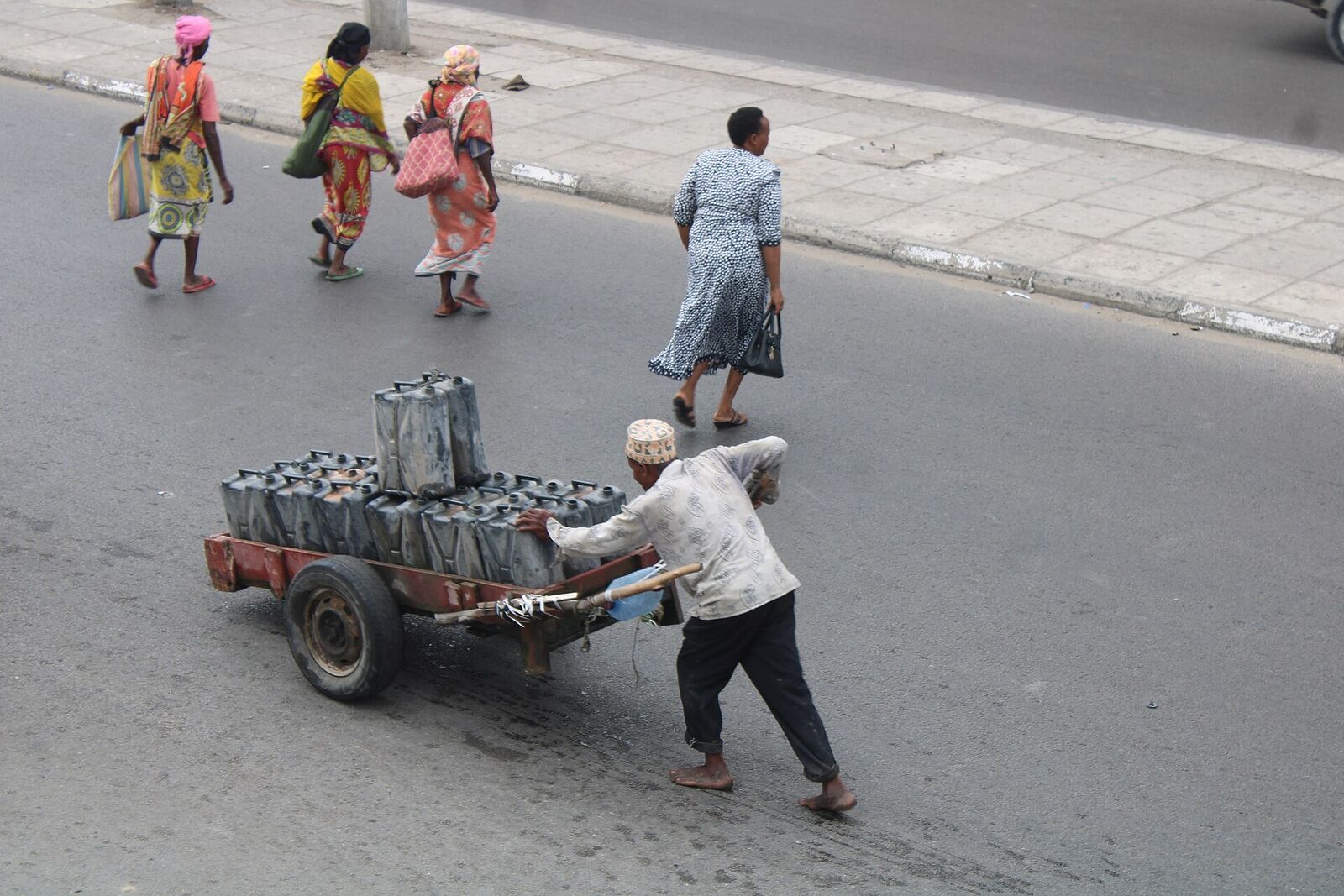
Water (Kiswahili: Maji) is a theme of the Infrastructure pillar. It covers water supply, sanitation and the water resources the coast depends on, including the Mzima and Baricho sources. Much of the region’s piped water travels long distances: a single bulk system draws on Mzima Springs in Taita-Taveta, Marere Springs and the Tiwi boreholes in Kwale, and the Baricho well field in Kilifi, and Mombasa has no local sources of its own.1 Mombasa’s demand is estimated at about 200,000 cubic metres a day against a supply of about 50,000.2
What this page is for
This is the shared starting point for water on the coast: please add the projects, organisations, data and stakeholder views you know about, so that everyone can read them side by side.
Water on the coast today
At the 2019 census the share of households with safe drinking water was 71 per cent in Kilifi County, 68.8 per cent in Lamu County, 68.7 per cent in Taita-Taveta County, 56.6 per cent in Mombasa County, 56.2 per cent in Kwale County and 55 per cent in Tana River County, against 58.8 per cent nationally. Access to improved sanitation ranged from 91.1 per cent in Mombasa to 41.8 per cent in Tana River.3
Supply falls well short of demand in the towns. Kwale’s water master plan put county demand at 51,961 cubic metres a day in 2015, rising to about 92,817 by 2030, while the county utility supplies about 17,778 cubic metres a day through some 10,000 active connections.4 Losses are high: Mombasa’s governor has said that 60 per cent of the county’s water is lost to illegal connections, leaks and meter tampering,5 and Tana River’s plan puts non-revenue water at 70 per cent for its utility.6 In the regulator’s 2023/24 ranking, Mombasa and Tana were the weakest utilities in their size groups, the Taita-Taveta utility faced governance and debt problems, and none of the utilities drawing on the coast bulk system had signed supply agreements or paid their bills consistently.
The existing supply is fragile. In November 2025 a rupture of the Mzima pipeline inside Tsavo left towns in Taita Taveta, Kwale, Kilifi and Mombasa short of water.7 In Lamu, the Shela sand dunes are the only aquifer for Lamu and Manda islands, and the county has used small desalination plants to reach households in Lamu East.8
Plans and policy
The Coast Water Works Development Agency, created under the Water Act 2016 and gazetted in 2019, develops water and sanitation infrastructure for the region,9 while county-owned utilities deliver the services. The largest scheme is the Mwache Dam in Kwale, co-financed by the World Bank and the Government of Kenya, which is designed to supply about 186,000 cubic metres a day to Mombasa and parts of Kwale.1011 The concrete of the main dam was completed in August 2026. A loan of 120 million euros from the French development agency AFD, running from 2018 to 2028, finances a treatment plant, pipelines to Mombasa’s reservoirs and work to cut losses at the Mombasa utility. A second Mzima pipeline of 220 km, meant to raise supply along the corridor from 86,000 to 186,000 cubic metres a day, was halted in March 2024.12
The county plans for 2023-2027 echo these priorities. Mombasa’s plan reports that the county’s network grew from 80 km to 182 km and that a proposed 100,000 cubic metre a day desalination plant did not go ahead.13 Taita Taveta lists bulk water from Njoro spring and the second phase of Mzima among projects it hopes to fund through partnerships.14 Mombasa’s county government has set targets to cut losses from 60 to 30 per cent by 2027 and raise household connections from 20,000 to 120,000.
Who is involved
The Ministry of Water, Sanitation and Irrigation leads the Mwache Dam, and the Coast Water Works Development Agency builds and runs bulk infrastructure. The Water Services Regulatory Board regulates the county utilities, which on the coast include Mombasa, Malindi, Kilifi-Mariakani, Kwale, Tavevo, Lamu and Tana. The six county governments set water priorities in their development plans, as described above. Development partners include the World Bank and AFD, and Sinohydro is the Mwache contractor. Private firms have proposed desalination, among them Rasli Bahari Kenya Limited for Lamu.15
Open questions
Who gets Mwache water first, and are those displaced made whole? In May 2026 a parliamentary committee found the dam 83 per cent complete but with no money yet set aside for pipes or a treatment plant, and its chairman, Kangogo Bowen, asked that Kwale residents be served before Mombasa. Matuga MP Kassim Tandaza wants full compensation for homes damaged by blasting, while the ministry has recommended repairs; about 2,000 of 4,000 affected people were still awaiting compensation.16
Is a second Mzima pipeline needed? Water Cabinet Secretary Zachariah Njeru froze the Sh35 billion project in 2024 as too expensive and short of investors. After the 2025 rupture, residents and local leaders called for an alternative line so that a single failure does not cut supply to four counties.
What role for desalination? Mombasa’s plan says its 100,000 cubic metre a day desalination project failed for lack of a national guarantee once the Mwache Dam was adopted. Rasli Bahari Kenya Limited has since proposed a Sh103.3 billion desalination plant in Lamu as a public-private partnership, and the plan’s project pages include Mombasa Private Desalination Plant and Pwani Decentralised Solar Desalination Network.
Can losses be cut before supply is added? Mombasa’s governor treats losses as a matter of enforcement against illegal connections, including by officials, while the regulator points to unpaid bulk water bills that threaten the coast bulk system’s finances.
Coverage the plan expects
- urban water supply
- rural water access
- sanitation
- water resources and catchments
- desalination
- drought resilience
- non-revenue water and utility performance
Sources
- Impact 17: A Performance Report of Kenya’s Water Services Sector 2023/24, Water Services Regulatory Board, 2025
- Kenya County Fact Sheets, Third Edition, Commission on Revenue Allocation, 2022
- Kenya: Improving drinking water and sanitation systems for coastal communities, Agence Française de Développement
- Coast Water Works Development Agency, official website
- Mombasa City County Integrated Development Plan 2023-2027, County Government of Mombasa, 2023
- Kwale County Integrated Development Plan 2023-2027, County Government of Kwale, 2023
- Sh25.5b Mwache dam hits 83pc completion amid funding, compensation concerns, The Standard, 2026
- Mzima 2 water project, Construction Kenya, 2024
Footnotes
-
Impact: A Performance Report of Kenya’s Water Services Sector 2023/24 (Issue 17), Water Services Regulatory Board, 2025, pages 40, 91 and 92. ↩
-
Kenya: Improving drinking water and sanitation systems for coastal communities, Agence Française de Développement, project page, accessed October 2026. ↩
-
Kenya County Fact Sheets, Third Edition, Commission on Revenue Allocation, 2022, pages 7, 95, 120, 130, 165, 220 and 225. ↩
-
Kwale County Integrated Development Plan 2023-2027, County Government of Kwale, 2023, pages 113 and 114. ↩
-
Governor Abdulswamad Nassir reveals 21 senior officials involved in illegal water connections, Farhiya Hussein, The Eastleigh Voice, 19 August 2025. ↩
-
Tana River County Integrated Development Plan 2023-2027, County Government of Tana River, 2023, page 24. ↩
-
Water shortage hits coast region after Mzima pipeline bursts, Julius Joho, Citizen Digital, 3 November 2025. ↩
-
Lamu County Integrated Development Plan 2023-2027, County Government of Lamu, 2023, page 23. ↩
-
Coast Water Works Development Agency, official website, accessed October 2026. ↩
-
Mwache Dam to end Mombasa’s water crisis, Sadik Hassan, Kenya News Agency, 23 March 2025. ↩
-
Mwache Dam enters final construction phase as main structure completed, Citizen Digital, 4 September 2026. ↩
-
Mzima 2 water project, Albert Andeso, Construction Kenya, 6 March 2024. ↩
-
Mombasa City County Integrated Development Plan 2023-2027, County Government of Mombasa, 2023, page 33. ↩
-
Taita Taveta County Integrated Development Plan 2023-2027, County Government of Taita Taveta, 2023, page 201. ↩
-
Firm to build Sh103.3bn desalination plant in Lamu, Kevin Rotich, Capital FM, 5 August 2025. ↩
-
Sh25.5b Mwache dam hits 83pc completion amid funding, compensation concerns, Patrick Beja, The Standard, 6 May 2026. ↩
Projects
Related pages
Holding
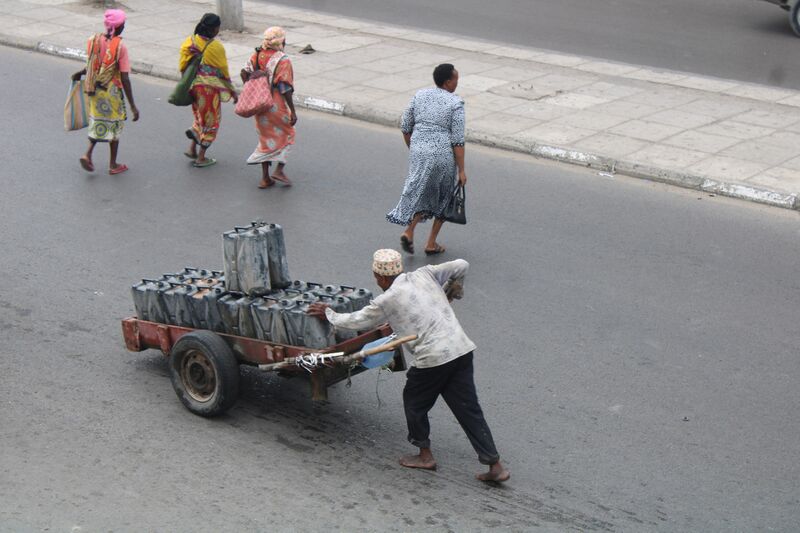
Water theme, mkokoteni water vendor in Mombasa
A water vendor pushing a mkokoteni (handcart) loaded with about twenty jerrycans of drinking water along a street in Mombasa, February 2020, with people walking past in the background.
Holding
Water theme, Mzima Springs
The clear pool at Mzima Springs in Tsavo West National Park, fringed with acacia and papyrus (December 2023).
Reference
Coast Water Works Development Agency, official website, accessed October 2026.
Coast Water Works Development Agency, official website, accessed October 2026.
Reference
Mzima 2 water project, Albert Andeso, Construction Kenya, 6 March 2024.
Mzima 2 water project, Albert Andeso, Construction Kenya, 6 March 2024.
Reference
Mombasa City County Integrated Development Plan 2023-2027, County Government of Mombasa, 2023, page 33.
Mombasa City County Integrated Development Plan 2023-2027, County Government of Mombasa, 2023, page 33.
Reference
Firm to build Sh103.3bn desalination plant in Lamu, Kevin Rotich, Capital FM, 5 August 2025.
Firm to build Sh103.3bn desalination plant in Lamu, Kevin Rotich, Capital FM, 5 August 2025.
Reference
Mwache Dam to end Mombasa's water crisis, Sadik Hassan, Kenya News Agency, 23 March 2025.
Mwache Dam to end Mombasa's water crisis, Sadik Hassan, Kenya News Agency, 23 March 2025.
Reference
Kwale County Integrated Development Plan 2023-2027, County Government of Kwale, 2023, pages 113 and 114.
Kwale County Integrated Development Plan 2023-2027, County Government of Kwale, 2023, pages 113 and 114.
Reference
Sh25.5b Mwache dam hits 83pc completion amid funding, compensation concerns, Patrick Beja, The Standard, 6 May 2026.
Sh25.5b Mwache dam hits 83pc completion amid funding, compensation concerns, Patrick Beja, The Standard, 6 May 2026.
Reference
Tana River County Integrated Development Plan 2023-2027, County Government of Tana River, 2023, page 24.
Tana River County Integrated Development Plan 2023-2027, County Government of Tana River, 2023, page 24.
Reference
Lamu County Integrated Development Plan 2023-2027, County Government of Lamu, 2023, page 23.
Lamu County Integrated Development Plan 2023-2027, County Government of Lamu, 2023, page 23.
Reference
Taita Taveta County Integrated Development Plan 2023-2027, County Government of Taita Taveta, 2023, page 201.
Taita Taveta County Integrated Development Plan 2023-2027, County Government of Taita Taveta, 2023, page 201.
Reference
Governor Abdulswamad Nassir reveals 21 senior officials involved in illegal water connections, Farhiya Hussein, The East
Governor Abdulswamad Nassir reveals 21 senior officials involved in illegal water connections, Farhiya Hussein, The Eastleigh Voice, 19 August 2025.
Reference
Kenya County Fact Sheets, Third Edition, Commission on Revenue Allocation, 2022, pages 7, 95, 120, 130, 165, 220 and 225
Kenya County Fact Sheets, Third Edition, Commission on Revenue Allocation, 2022, pages 7, 95, 120, 130, 165, 220 and 225.
Reference
Impact: A Performance Report of Kenya's Water Services Sector 2023/24 (Issue 17), Water Services Regulatory Board, 2025,
Impact: A Performance Report of Kenya's Water Services Sector 2023/24 (Issue 17), Water Services Regulatory Board, 2025, pages 40, 91 and 92.
Reference
Water shortage hits coast region after Mzima pipeline bursts, Julius Joho, Citizen Digital, 3 November 2025.
Water shortage hits coast region after Mzima pipeline bursts, Julius Joho, Citizen Digital, 3 November 2025.
Reference
Kenya: Improving drinking water and sanitation systems for coastal communities, Agence Française de Développement, proje
Kenya: Improving drinking water and sanitation systems for coastal communities, Agence Française de Développement, project page, accessed October 2026.
Reference
Mwache Dam enters final construction phase as main structure completed, Citizen Digital, 4 September 2026.
Mwache Dam enters final construction phase as main structure completed, Citizen Digital, 4 September 2026.
Theme
Agriculture
This is the shared page for farming on the coast: please add the projects, organisations, data and farmer and stakeholder views you know about, with a source for each.